Tel.: 008615989623158
E-mail: sales@grandetop.com


Tel.: 008615989623158
E-mail: sales@grandetop.com
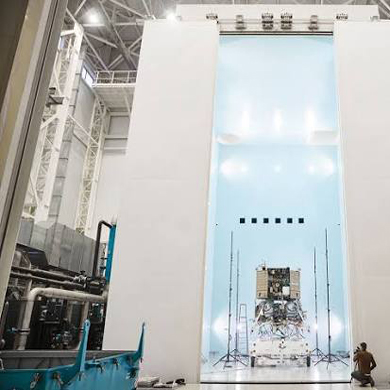
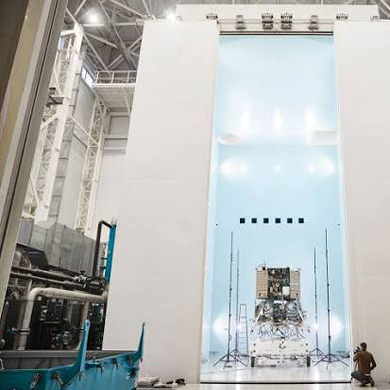
Reverberation Acoustic Chamber Facility
Reverberation Chambers
The core purpose of these reverberation chambers is the same: to simulate on the ground the intense acoustic environment that spacecraft experience during launch and flight, so as to verify structural reliability and equipment safety. Their differences lie mainly in the target spacecraft and mission phase they serve — the larger the chamber capacity, the larger the spacecraft it can accommodate.
Standards
MIL-STD-810H Method 515.8
This Method includes three acoustic noise test procedures. Determine which of the following procedure(s) to be used.
a. Procedure I (Diffuse Field): Ia – Uniform Intensity Acoustic Noise, Ib – Direct Field Acoustic Noise.
b. Procedure II (Grazing Incidence Acoustic Noise)
c. Procedure III (Cavity Resonance Acoustic Noise).
GJB 150.17A-2009 — Laboratory environmental test methods for military materiel — Part 17: Acoustic noise test
GJB 1027A-2020 — Test requirements for launch vehicles, upper stages, and spacecraft
GJB 1197A-2017 — Acoustic test method for spacecraftJJF 1143 — Calibration specification for reverberation boxes
ISO 3742 — Determination of sound power levels of noise sources — Precision methods for discrete-frequency and narrow-band sources in reverberation rooms
ISO 3743 — Determination of sound power levels of noise sources — Engineering methods for special reverberation test rooms
GB 6881-2016 — Determination of sound power levels of noise sources — Precision and engineering methods for reverberation rooms
Overview of the Main Reverberation Chambers
1,070 m³ Reverberation Chamber
This is a relatively classic reverberation chamber.
Structure and design: The main body is a hexahedron with internal dimensions of 12 m (height) × 10.5 m (length) × 8.5 m (width). The walls use a double-layer inner-and-outer-wall structure, and the door is a sliding steel structure.
Acoustic performance: After tuning, its maximum overall sound pressure level can reach above 155 dB. The calculated reverberation time (T60) is approximately 18.34 seconds.Application: It is mainly used to simulate the noise environment that spacecraft experience during launch and flight. Its main test objects are large and medium-sized satellites and their components.
Body structure and dimensions
Internal dimensions: 12 m (height) × 10.5 m (length) × 8.5 m (width), hexahedral structure.Walls: Double-layer structure; the inner wall is reinforced concrete with a thickness of 0.5 m. The foundations of the inner and outer walls are separated to avoid acoustic bridges.
Door: A sliding steel integral door, 7.6 m high, 5.6 m wide, and 0.5 m thick, with a total mass of about 30 t. The calculated sound insulation of the door is about 59.5 dB, and an inflatable sealing ring is used to ensure tightness.
Acoustic performance
Maximum overall sound pressure level: Above 155 dB during acceptance tuning. The theoretical maximum sound pressure level can reach 160 dB (estimated based on a total sound power of 8×10⁴ W from four 2×10⁴ W acoustic generators).
Reverberation time: Calculated by the classical formula, T60 is approximately 18.34 seconds.Sound source configuration: Four exponential horns are installed in the loudspeaker room at the top, with cutoff frequencies starting from 40 Hz.
2,163 m³ Reverberation Chamber
This is a larger reverberation chamber, also used for spacecraft dynamic environment testing.Mission positioning: It is a key facility for completing the first and second phases of the manned space engineering program, used to expose material, component, and process defects in spacecraft and to verify the rationality of the whole-spacecraft design.
Performance: The maximum overall sound pressure level of this reverberation chamber can reach 153.8 dB. Related studies have been conducted to test and improve its high-frequency performance.
Body structure and dimensions
Internal dimensions: 11 m (length) × 9.5 m (width) × 20.7 m (height), in the shape of an orthogonal hexahedron.
Volume and surface area: Volume approximately 2,163 m³; internal surface area approximately 1,057.7 m².
Walls and sound insulation: The main body has a double-layer wall structure; the average absorption coefficient of the inner wall is less than 1.3%, and the outdoor ambient noise is below 65 dB.
Door: An electric sliding reinforced-concrete integral door, 6 m wide and 12.5 m high, with a total mass of about 100 t and a first-order resonance frequency below 20 Hz.
Acoustic performance
Maximum overall sound pressure level: 153.8 dB; maximum spectrum-shaped sound pressure level: 147 dB.
Reverberation time: About 21.25 seconds on average (the standard requires more than 10 seconds).
Sound field uniformity: Spatial variation not exceeding 1.57 dB (standard: 3 dB).
Low-frequency modes: In the 31.5 Hz 1/3-octave band, the minimum modal density is 8 modes.
Sound sources and control system
Gas source: Nitrogen is used as the supply gas.
Horn configuration: Four exponential horns with cutoff frequencies of 28 Hz, 40 Hz, 100 Hz, and 160 Hz, respectively.
Acoustic generators: Early units included the American Wyle WAS-3000 (maximum power 30 kW) and the Tianjin Qimei QM-10000 (maximum power 10 kW). To improve high-frequency performance, acoustic generators such as the EPT-200 and ENSG-20000-250 were later introduced for experimental research.
Control system: The self-developed ATCS-100 acoustic test control system, with an analysis frequency range of 20–10,000 Hz, a resolution of 10 Hz, and an equalization loop time of 2 s.
4,000 m³ Reverberation Chamber
Main objects: Ultra-large spacecraft, such as space station modules (e.g., "Test Module I") and large satellites.
Mission positioning: Developed to meet the needs of the third phase of the manned space engineering program (space station construction), representing internationally leading test capability. It has completed noise tests on space station-related modules, laying an environmental verification foundation for subsequent launch and operation.
The 4,000 m³ large reverberation chamber noise test system was developed to meet the development needs of the manned space station and large satellites. Once completed, the facility's scale is considerable in Asia and even worldwide.
Core physical and acoustic parameters
Effective volume: 4,000 m³, one of the largest acoustic test facilities in Asia.
Internal dimensions: 14.5 m (length) × 11.5 m (width) × 24 m (height). This dimensional design ensures sufficient acoustic modes in the low-frequency range (e.g., around 25 Hz).
Maximum overall sound pressure level: Above 156 dB (empty-chamber condition).
Sound field uniformity: Better than ±1 dB within the test volume.
Door dimensions: 10 m × 22 m (width × height), sliding door, with a door body mass of about 200 t, sufficient to accommodate the entry and exit of large spacecraft.
Wall thickness: 0.7 m, for sound insulation.
Accommodatable test articles: Spacecraft up to 7.5 m in diameter, 18.5 m in height, and 30 t in weight.
Supporting system parameters
Gas supply system: Nitrogen is used, with a maximum flow rate of 800 Nm³/min and a pressure of 2.5±0.1 bar. The system is designed to support up to 10 full-flow acoustic tests per day, each lasting 3 minutes. Liquid nitrogen is stored in two 30 m³ tanks.
Sound source configuration: Includes 2 LF-60 modulators, 6 EPT-200 modulators, and 10 domestically produced modulators, connected to exponential horns with different cutoff frequencies (20 Hz to 200 Hz).